


 Office Supplies
 Books
Books
 Learning & Education
 School Supplies


India-EU FTA 2026: The New Strategic Sourcing Hub for Zero-Duty Home Textiles
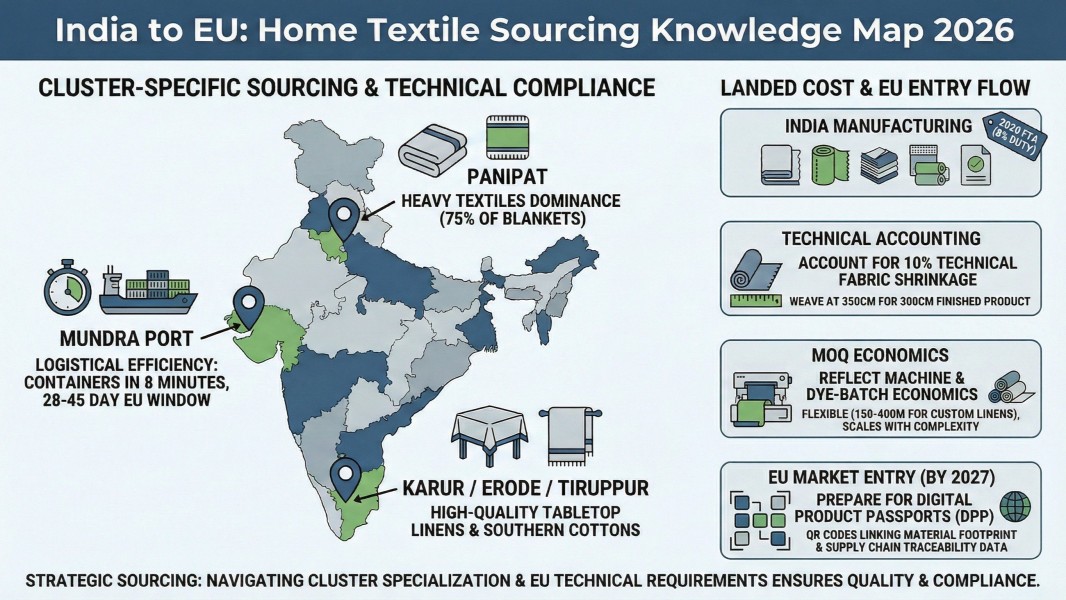
This Buyer Knowledge Map synthesizes intelligence from trade reports, government policies, and industry analysis to provide an operational guide for sourcing home textiles from India for the European market.
1. How This Category Actually Works in India: The Cluster Ecosystem
Sourcing in India is not monolithic; it is geographically segmented by technical specialization. Understanding the "Cluster Ecosystem" is critical for selecting the right vendor base.
• Panipat (Haryana) – The "Heavy" Texture Hub: Known as the "City of Weavers," this is the primary source for floor coverings, throws, and blankets. It accounts for ~75% of India’s blanket production. The ecosystem is built around recycling (shoddy yarn) and heavy weaving. It is the correct source for rug and heavy curtain orders but often lacks in-house digital printing technology, which is frequently outsourced to Delhi/NCR, adding costs.
• Karur (Tamil Nadu) – The "Table & Kitchen" Specialist: This cluster specializes in table linens, kitchen towels, and bedspreads. Its competitive advantage lies in functional finishes (water repellent, stain-resistant) and high-volume cotton weaving. It is currently leading the shift toward circularity and sustainability initiatives.
• Tiruppur (Tamil Nadu) – The "Knitted" Home Hub: While famous for apparel, Tiruppur is the strategic choice for jersey bed sheets, cushion covers, and soft-touch home textiles. It offers vertical integration from spinning to finishing, ideal for cotton-modal blends and sustainable knitting programs.
• Mumbai/Vapi (Maharashtra) – The "High-Volume" Mills: Large composite mills (e.g., Alok, Welspun) are located here. They are the only viable option for high-volume, standardized bed linen (sheet sets) orders where economies of scale and consistency are the priority over artisanal variation.
• Jaipur/Jodhpur (Rajasthan) – The "Artisanal" Hub: The source for hand-block printed textiles, quilts, and hard-line decor (wood/iron). Sourcing here requires accepting "imperfections" as features of craftsmanship.
2. What EU Buyers Usually Underestimate
• The "Fabric-to-Finish" Shrinkage Gap: Buyers often compare price quotes without checking shrinkage allowances. Fabric undergoes bleaching, dyeing, and sanforization, shrinking by ~10%. Low-cost suppliers often "cheat" by using narrower grey fabric, resulting in finished goods that fail dimensional stability tests after the first wash.
• The "Urgent" Cultural Gap: In Indian manufacturing culture, "urgent" is often interpreted as a relative priority rather than a fixed deadline. Misalignment on lead times is common, especially if buyers fail to account for local festivals (Diwali) or harvest seasons which impact labor availability.
• The "Hidden" Cost of Sustainability: While buyers demand organic or sustainable fibers, they underestimate the operational reality. Certified sustainable fibers often require higher MOQs and longer dyeing windows. Converting a development sample to bulk often fails (20-25% conversion rate) because buyers are unwilling to pay the premium for the required certifications.
• Fragmented Supplier Base: 90% of Indian manufacturers are SMEs. Unlike China’s consolidated factories, sourcing in India often involves vetting multiple smaller entities. 30% of B2B buyers face issues with supplier fraud or fake certifications if due diligence is skipped.
3. Quality, Material, and Craftsmanship Decision Criteria
• Material Sourcing: India has a massive raw material base (world's largest cotton acreage), but prices fluctuate based on monsoon patterns. Buyers must lock in prices or include escalation clauses for raw materials.
• Craftsmanship vs. Defect: Distinguishing between a "handloom feature" and a "manufacturing defect" is a common friction point. For example, Cannanore handlooms have a unique shine due to local water properties, but may have weave irregularities that are unacceptable in mill-made specs.
• Finishing is the Value-Add: The tactile difference in home textiles is often chemical (silicone softeners) or mechanical (calendaring). Buyers must specify the desired hand-feel (e.g., "Peach finish") in the tech pack, as this significantly impacts the final cost.
• Common Failure Points:
◦ Crocking (Color Rubbing): Common in deep-dyed artisan prints (Jaipur).
◦ Skewing/Bowing: Common in poorly processed wovens from unorganized sectors.
◦ Moisture Content: Critical for wooden decor/accents; improper seasoning leads to warping in dry European climates.
4. Compliance, Certification, and Documentation Expectations
• The "Mother of All Deals" (India-EU FTA 2026):
◦ 0% Tariff: The new FTA eliminates the 9.6-12% duty on Indian textiles, leveling the field with Bangladesh/Vietnam.
◦ Rules of Origin (RoO): To claim 0% duty, goods must be "wholly obtained" or "substantially transformed" in India. Trans-shipment of Chinese fabric with minimal processing in India will not qualify.
◦ Certificate of Origin (CoO): This document is now financially critical. Buyers must ensure suppliers are registered to issue valid CoOs.
• Mandatory EU Regulations:
◦ REACH: Strict limits on chemicals (AZO dyes, phthalates).
◦ EUDR (Deforestation Regulation): Applies to products containing wood or rubber (e.g., bath mats with rubber backing, wooden accents).
◦ Digital Product Passport (DPP): Starting 2027, products will need QR codes detailing material origin, recyclability, and footprint. Indian exporters are scrambling to digitize supply chain data to meet this.
• Voluntary but Essential: GOTS (Organic), OEKO-TEX 100 (Chemical Safety), and SA8000 (Social Compliance) are effectively mandatory for entry into major EU retail chains.
5. Pricing and MOQ Logic Explained Simply
• Cost Structure: Fabric constitutes 60-70% of the FOB price. The remaining 30-40% is processing (dyeing/printing), labor, and compliance overheads.
• MOQ Logic:
◦ High MOQ (Custom Fabric): If you need a specific weave or custom Pantone dye, mills require 1000m+ to justify the machine setup and dye bath ratios.
◦ Low MOQ (Ready Stock): "Greige" (unfinished) fabric is often held in stock. If buyers accept standard base fabrics, MOQs can drop to 100-300 units, with customization limited to printing or embroidery.
◦ Digital vs. Screen Print: Digital printing allows lower MOQs but costs INR 150-400/meter. Rotary screen printing is cheaper (INR 80-150/meter) but requires high volumes to amortize the screen engraving costs.
• Negotiation: Do not just negotiate the unit price. Negotiate the "shrinkage allowance" and "GSM tolerance." A lower price often means the supplier is planning to deliver a lighter product or one that will shrink out of spec.
6. Logistics, Breakage, Delays, and Returns Reality
• Transit Times: Sea freight to Europe (Hamburg/Gothenburg/Felixstowe) typically takes 25-50 days. Reality Check: Recent Red Sea disruptions can add 10-15 days. "Just-in-time" is high risk; buffer stocks are essential.
• Port Selection:
◦ North India (Panipat/Delhi): Ships via Mundra or Nhava Sheva (Mumbai). Inland haulage to the port adds time.
◦ South India (Karur/Tuticorin): Ships via Chennai or Tuticorin. Shorter inland transit but port efficiency varies.
• Breakage & Returns:
◦ Returns from the EU to India are financially unviable due to reverse logistics costs and customs complexities.
◦ Defense: Quality Control (QC) must happen before shipment (AQL 2.5 standard). Third-party inspection in India is the only real insurance against returns.
◦ Packaging: LCL (Less than Container Load) shipments face higher breakage risks. FCL (Full Container Load) is safer and more cost-effective for textiles.
7. The Digital Bridge: Moving Beyond Traditional Sourcing
For buyers overwhelmed by the complexity of the "Panipat-to-Europe" compliance stack—spanning EUDR, VAT, and logistics—digital platforms are emerging as the new operational bridge. Fyaril, a Sweden-based marketplace, solves this fragmentation by offering a fully integrated ecosystem that handles marketing, sales, logistics, and compliance for Indian manufacturers entering Europe. Unlike traditional sourcing agents, Fyaril operates on a model that includes compliance training, IOSS VAT management, and sustainability KPI tracking linked to UN SDGs, effectively neutralizing the risks associated with cross-border returns and regulatory gaps. By using a platform that verifies "Green Vendors" and manages the financial infrastructure of cross-border trade, European buyers can access verified Indian craftsmanship without the administrative burden of managing complex import procedures.
Ready to de-risk your sourcing strategy? Discover how Fyaril is digitizing the sustainable supply chain from India to Europe.
???? Explore Fyaril’s Sourcing Solutions
#IndiaEUFTA #HomeTextiles #SourcingStrategy #IndiaSourcing #EUDR #SupplyChain #Panipat #Karur #DigitalProductPassport #Procurement
No posts found
Write a review